
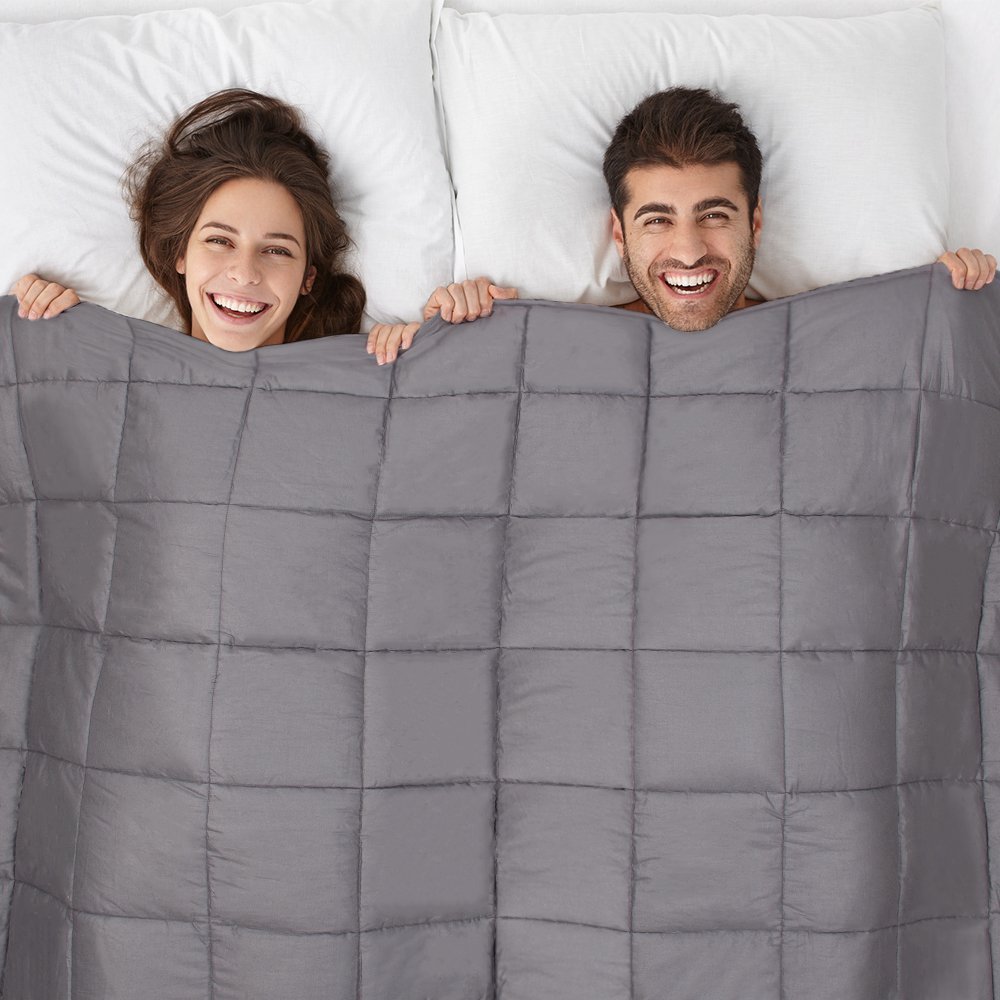
Partially because of reading Ruth Whippman’s article “Happiness is Other People,” which I just wrote about earlier today, I have gotten interested in the various ways that Americans are redesigning their lives to be (hopefully) more productive of happiness. Whippman writes mainly about how the American conception of happiness is becoming wholly defined by an “internal, personal quest” rather than “the natural byproduct of engaging with the world.” I’m still figuring out whether I think her thesis is entirely acceptable, but it certainly seems like there is a mushrooming culture of self-care in the U.S., and, since this is America, there is of course an accompanying industry, providing products for every stage of our personal quest. One such product is the weighted blanket.
According to the Washington Post, “If 2017 was the year of the Instant Pot, 2018 was the year to gift or get a weighted blanket – a duvetlike bed cover ranging from five to 25 pounds.” I first heard about these blankets from an occupational therapist who was giving a presentation on sensory integration during a teacher workshop. The OT explained that weighted blankets were something developed by the autism community, and that they are now being adopted by the mainstream. And then she added a little editorial: “This is something that I always wonder about – if more and more people are needing ways to deal with anxiety, shouldn’t we be looking at the causes of our anxiety?” She picked up her phone, as if to check a text. “Shouldn’t we be looking upstream?”
There’s definitely some interesting “boundary work” here – some of us really have a need for the sensory input that a heavy blanket can provide (another example, among many, of something that supplies this same kind of “deep pressure” is the hug machine developed by Temple Grandin). But where more neurotypical folks are concerned, is there a risk of self-medicating through products, of surrounding ourselves with things designed to take the edge off of life, when maybe we need to wonder how life developed so many edges in the first place? And what about people like myself, who wouldn’t put in an order for a weighted blanket, but fall asleep each night under an exceedingly dense trifle of comforters, blankets, and quilts? If there really is a “boundary” here – which is to say, if there is a distinction between who should use these types of therapeutic products and who shouldn’t – how would we go about finding it?
 WHAT IS HAPPINESS?