
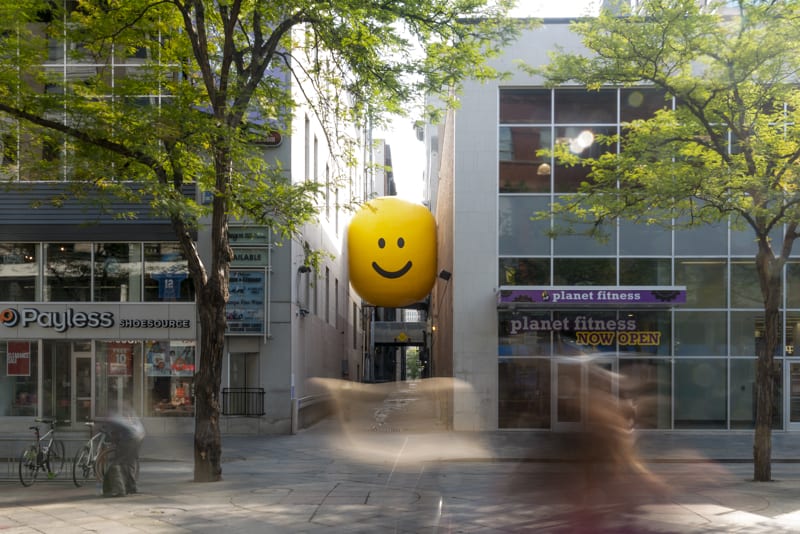
I am a newcomer to the work and personality of Stuart Semple. He has recently enlarged his fame through a public feud with the sculptor Anish Kapoor over very, very black paint, which is in fact how I first found out about him. This feud has culminated in Semple’s development of “Black 3.0,” which is described as “The blackest black paint in the world!” on the Kickstarter page created to fund its initial production run (the funding campaign has raised about $510,000 more than the original goal of $32,709). After learning that Semple was an artist as well as a paint maker and provocateur, I was curious to find out more about his work.
I visited Semple’s website, which describes him as “a true artistic polymath and creative innovator,” and I was a few pages deep when I came across an image of a site-specific sculpture titled I should be crying but I just can’t let it show… (2018) I assumed that I understood the piece immediately – even without the denial-themed title, there seems to be a palpable anxiety behind the banal smiley-face. This is certainly the visage of someone who is doing their best to keep up appearances, even as the soft sphere of their head is about to be crushed by the ever-encroaching walls of a Planet Fitness and a Payless Shoesource. And yet, here is what the website says about it: “The piece aims to illustrate the human capacity to persevere under stress and pressure.” And then, apparently quoting the artist: “It’s kind of about some sort of inner resolve, maybe there’s a place in us where happiness lives. Perhaps this place isn’t actually effected by outside fluctuations. That part of us is more powerful than most people know. I’m hoping the piece will help people to connect to that and take some strength in it.”
Mystified, but still interested, I sought out more of Semple’s work. In a review of a group show that Semple co-curated and participated in, Adam Ganderson described a featured installation as “what one could imagine being the bedroom of the fictitious offspring of Andy Warhol and Jeff Koons, as styled for MTV.” This description comes up in a lot of articles about Semple, and it is a pretty apt one. In addition to his sculpture and performance pieces, much of the UK-based artist’s work consists of brightly colored canvases featuring found images and abundant references to pop culture.
And it turns out that I should be crying wasn’t Semple’s first foray into the use of the smiley-face. In 2009, he debuted his Happy Clouds on the grounds of the Tate Modern, and the performance has traveled internationally since. Essentially, a machine extrudes smiley-face shaped “clouds” which are made out of a mixture of helium and soap; these clouds then float in the air, alighting on buildings and catching the light of the sun, until they fall back to earth or dissolve completely in the atmosphere. In describing the public reception to the piece, a cheerful Semple told the Telegraph that “People have been quite happy, a lot of school kids trying to grab the clouds, people smiling, and so it’s done what I hoped it would.” This notwithstanding, I find them a bit terrifying. The clouds drift through the air, becoming unmoored by capricious breezes; they lose pillowy chunks of white flesh at random intervals and seem especially vulnerable to the outstretched arms of the nearby trees, which seem keen on grabbing them, too. As their lifespan nears completion, their smiles relax into an almost Munchesque gape as they fall, powerless, into the grey expanse of the Thames.
That black paint looks super great, though!
 WHAT IS HAPPINESS?